
How We Flipped a Valencia Apartment in 10 Weeks

We didn’t set out to “flip” an apartment in Valencia. We found a tired place most buyers couldn’t even get a mortgage on, bought it in cash, and renovated it like we were going to live there for 20 or 30 years. Then life changed and we decided to sell. That gave us a rare look at the full Spanish cycle, start to finish: purchase, taxes, renovation, agents, notaries, capital gains, and finally selling.
Here’s what we did in 10 weeks, what it actually cost, what we sold it for, and whether the profit felt worth the stress and tradeoffs.
- The apartment was purchased for $210,000 in cash due to its unregistered square footage, limiting the buyer pool to cash buyers only.
- Renovations transformed the apartment into a 3-bedroom, open-plan space with upgraded materials, enhancing its market value significantly.
- The total cost of buying the apartment, including taxes and fees, was approximately $250,000 before renovations, highlighting the importance of considering additional expenses in real estate transactions.
🎬 Check out Original Content
Click above to experience the full content!
Our Spanish Apartment Experiment: Could We Buy, Renovate, and Sell for a Profit?
The experiment was simple: if we bought a “problem” apartment in Valencia for cash, fixed it up the way we’d actually want to live in it, and then sold it instead of renting it, would the profit and lifestyle tradeoffs be worth it?
On paper, it looked great. We bought the apartment for about $210,000, $215,000 in cash. Local agents told us they thought it was worth around $300,000 in its existing condition, so we believe we bought significantly under market. That gap, roughly $85,000, $90,000, is what made this interesting even before we touched a single tile or wall.
There was a specific reason for the discount. The previous owner was very elderly and hadn’t properly registered the square footage with Valencia.
Because the square footage wasn’t correctly registered, banks wouldn’t lend on it. Anyone who needed a mortgage simply couldn’t buy, which shrank the buyer pool to cash buyers only. On top of that, we felt the listing agents were a bit greedy and didn’t push their client to fix the registration issue or market it correctly, which helped us negotiate into that $210,000, $215,000 range.
From day one, we knew we had a great deal even before renovation. But we did not go into this planning a flip. We expected to keep the apartment long term, 20, 30 years, and that shaped almost every design and upgrade decision. We weren’t trying to do a bare‑bones flip; we were trying to create something we’d be happy living in for decades.
As bought, the place had unregistered square footage, an outdated layout, and tired finishes. By the time we were done, it was a 3‑bedroom, open‑plan apartment with upgraded materials and a proper connection to the terrace. So the real question became: if we sell this instead of holding it for 20, 30 years, does the profit justify the work, the cash tied up, and the fact that we never actually live there long term?
We sold roughly six months before recording this breakdown, which gave us enough distance to look at it as a real case study: here’s the purchase price (around $210,000, $215,000 cash), here’s what local agents thought it was worth at the time (around $300,000), here’s why we got the discount (unregistered square footage, banks wouldn’t lend, very elderly owner, weak listing strategy), and here’s what we turned it into (3‑bedroom, open‑plan, upgraded materials, terrace connection). The rest of this post is basically answering: did that combination of buying under market, renovating for ourselves, and then selling instead of renting actually work in Valencia, financially and lifestyle‑wise, or would we do it differently next time?
What It Really Cost to Buy an Apartment in Valencia, Spain (Taxes, Fees, and Hidden Costs)
In Spain, the headline price is only part of the story. The real “cost to buy” shows up once you add transfer tax, agent commissions, legal, bank, and closing fees. On our place, the raw purchase price was roughly $210,000, $215,000, but once everything was added, we were at about $250,000 before renovation.
Here’s the breakdown:
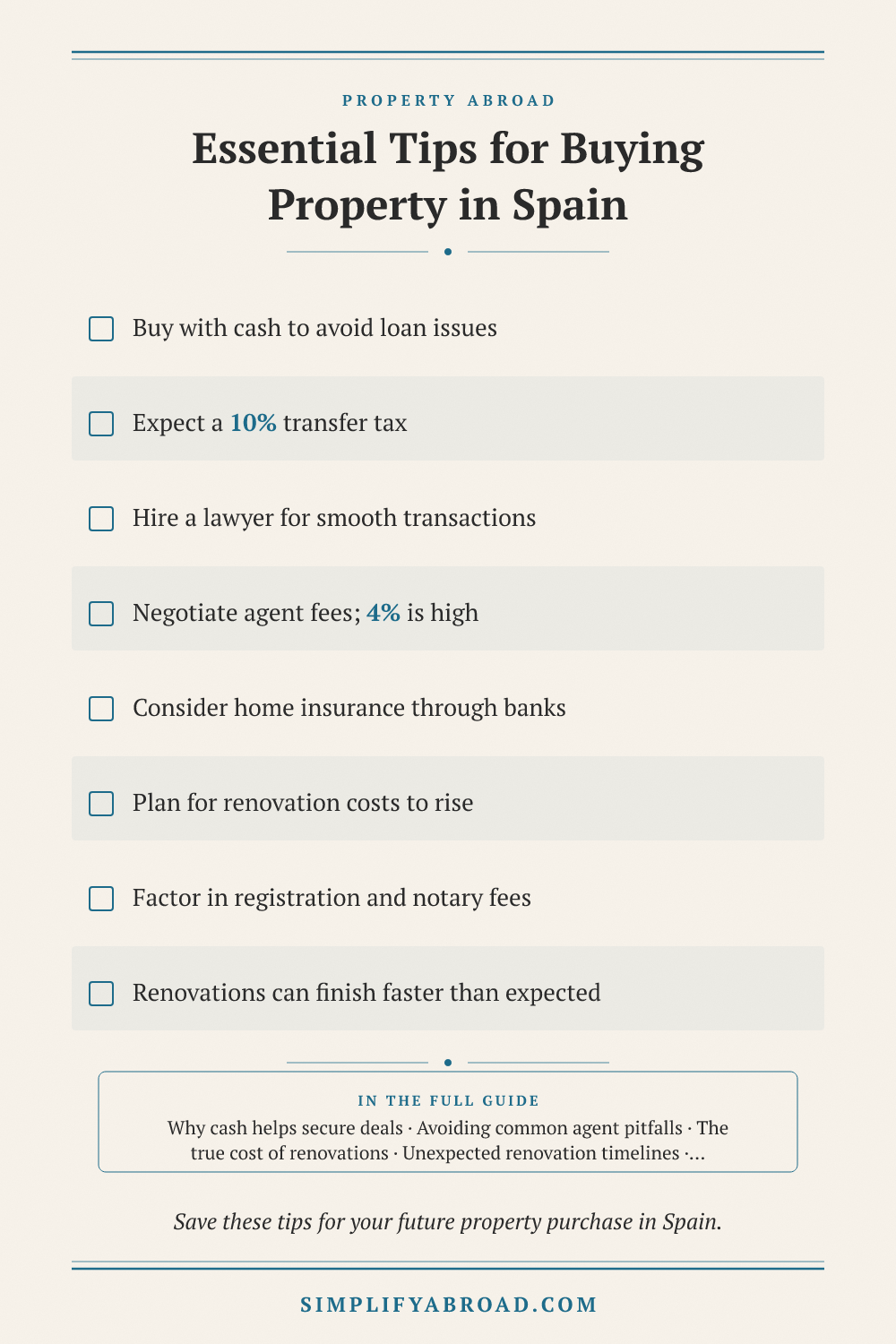
10% transfer tax (Valencia)
Valencia charges a flat 10% transfer tax on property purchases. No brackets, no scale. On our roughly $210,000 purchase, that was about $21,000 straight to the government.Seller’s agent commission: 4% + IVA
In this deal, the seller’s agent charged 4% plus IVA, which is high compared to the more typical 2, 3% you see in Spain. On our numbers, that was almost $10,000. It’s technically on the seller’s side, but it affects what you’re really paying to get into the property.Lawyer: ~$2,000
We hired a lawyer and paid about $2,000. Between legal checks, contracts, and Spanish bureaucracy, that fee was part of the true acquisition cost for us.Buyer’s agent “thank‑you”: ~$1,000
We also worked with a buyer’s agent, but the seller’s agent refused to split their fee. There was no shared commission, so we voluntarily paid the buyer’s agent about $1,000 as a thank‑you.Bank cashier’s check fee: negotiated from ~$1,000 down to ~€250
To move the money on closing day, we needed a cashier’s check. The bank initially tried to charge around $1,000 just to issue that check. We pushed back and got it down to about €250 by buying home insurance through Santander and bundling it with the transaction. For this kind of international transfer, we’ve also had a much better experience using tools like Wise to move dollars into euros at decent rates instead of getting hammered on bank FX spreads.Notary + registration: ~ $1,000
Standard notary and property registration fees were around $1,000 combined. Pretty typical closing costs in Spain.
Stepping back, here’s the key comparison:
- Raw purchase price: ~$210,000, $215,000
- True acquisition cost (with taxes & fees): ~$250,000
That ~$40,000 gap between the headline price and the “all‑in to own it” number is what really matters if you care about profit on a short‑timeline renovation.
Our Renovation Plan: Budget, Timeline, and Design Goals for a Valencia Apartment Remodel
We started this as a straightforward renovation, not a flip. The plan was: buy an older apartment in Valencia, do a full remodel, and end up all‑in for around the cost of a nicely finished place in the same area.
On paper, the Valencia apartment renovation budget breakdown was simple:
- Purchase + fees: ~$250,000
- Initial renovation quotes: $50,000, $60,000
- Expected all‑in cost: $310,000, $315,000
That “purchase + fees (~$250,000) + $50,000, $60,000 renovation = ~$310,000, $315,000 all‑in” equation was the mental model.
The timeline we were sold was also a big factor. The contractor pitched 6, 8 weeks for the entire renovation, not just demolition. If you’ve heard anything about typical Spanish renovations, you know that’s fast compared to the “many months to years” stories you usually hear. That 6, 8 week estimate made it feel like a contained disruption instead of an open‑ended project.
Design‑wise, we weren’t thinking “flip” at all. We were thinking about how we’d want to live there. Three main priorities:
Create three usable bedrooms
The original layout was choppy and one bedroom was tiny. We wanted three bedrooms side by side, with that tiny room turned into something that felt like a real bedroom.Open up the common areas
We wanted an open‑plan living/dining/kitchen instead of separate, closed‑off rooms, so it would function like a modern apartment.Maximize the connection to the terrace
The terrace is what originally drew us to the apartment, so we designed the open‑plan space to flow directly to it and make that indoor‑outdoor connection the center of the home.
So before there was any thought of profit or “10‑week flip,” the plan was: ~$310,000, $315,000 all‑in, 6, 8 weeks of work, three real bedrooms, an open common area, and a strong indoor‑outdoor connection to the terrace.
Inside the Renovation: Layout Changes, Budget, and High-End Upgrades We Chose
The big design move was turning this awkward, chopped‑up apartment into a three‑bedroom place with a true open‑plan living area that connects straight out to the terrace, a core part of our Valencia apartment remodel plan. Once that was set, we layered on higher‑end upgrades that pushed our renovation budget from the original $50,000, $60,000 plan up to roughly $80,000.
On the bedroom side, we:
- Put three bedrooms in a row instead of scattering them
- Gave two bedrooms large windows so they feel like full‑light rooms
- Made the third bedroom about 30% larger than the tiny original; it’s interior with no window, but actually usable instead of a fake “bedroom”
The center of the apartment became one open space: living room, dining room, and kitchen all connected to each other and to the terrace. The terrace itself was one of the main reasons we bought the apartment; it’s oriented so it gets sun in the morning but not in the afternoon, which means you can actually use it without it turning into an oven.
To support that layout, we moved the kitchen to a better spot and used the renovation as a chance to upgrade beyond the base spec:
- Higher‑end kitchen than the original quote
- Upgraded bathroom tiles
- Upgraded flooring throughout
We chose all of that with a 20, 30 year horizon in mind, not a quick refresh.
The single biggest upgrade, and honestly the star of the renovation, was the terrace door. We ripped out the old basic sliding glass door and installed a giant folding door that created real indoor‑outdoor living between the open‑plan space and the terrace. Specs:
- Roughly 3 meters (over 10 feet) tall
- Soundproofed
- Hurricane‑proof rating
That door was a major cost jump compared to a standard slider and was a meaningful part of why we went about $20,000 over the original renovation idea.
Important detail: that ~$80,000 total renovation cost wasn’t because of contractor overruns or delays. The extra $20,000 over the initial $50,000, $60,000 plan was entirely upgrades we chose: moving the kitchen, higher‑end kitchen spec, upgraded tiles and flooring, and that 3‑meter folding terrace door.
Renovation Timeline: How Our 8-Week Plan Became 10 Weeks
Our contractor told us the full renovation would take 6, 8 weeks from demolition through completion, and we wrapped in about 10 weeks total. So we ran about 2 weeks longer than the original promise, but in context, it still felt incredibly fast for a Spanish renovation.
Those extra two weeks were almost entirely about materials, not the crew disappearing or dragging things out. We were waiting on tiles and a few specific pieces that had to be on site before they could move forward with certain stages. The schedule slipped while everyone waited for deliveries, not because the team stopped working.
We were still very happy with 10 weeks because we’d already seen what “normal” looks like in Valencia. We have friends whose renovation stretched to 1.5, 2 years, and they eventually switched to our contractor just to get it finished. Before we started, people kept warning us a Spanish renovation would “take forever,” so compared to 18, 24 months, getting a full apartment done in about 10 weeks felt like a different universe.
From a timeline perspective, that speed also matters if you’re trying to create content around projects like this. We’ve gotten a lot of use out of taking raw project footage and turning it into written breakdowns using tools like ContentFold, which is how this ends up as a blog instead of just sitting in my camera roll.
Free guideThe Moving to Spain & Europe GuideGet it free →
Why We Sold Instead of Becoming Landlords in Valencia
We sold the Valencia apartment instead of renting it out because the entire reason for owning it disappeared, and we didn’t want to become landlords just because we could.
The original purpose of that apartment was clear: it was meant to be a base for Ryan’s mom inside the city, close to our kids’ school. When we bought it, our kids were going to school in the city while we were living outside the city, so having a place about a 6, 8 minute walk from school felt perfect. The idea was the kids could go there during comedor, have lunch, rest a bit, and meet tutors between school sessions without commuting back and forth. It wasn’t bought as an investment property or part of some grand flipping plan. It was about making daily life easier for our family.
Then things changed. Earlier in the year our son became ill, and Ryan’s mom went back to the United States.
Once she left, that original use case for the apartment disappeared overnight. At the same time, it was obvious that with our larger family and animals, the apartment was too small for us to live there full‑time. It was great as a base for one person and a midday landing spot for the kids, but not as a long‑term home for all of us.
That pushed us to rethink where we were living in Valencia with kids. Instead of trying to cram into that owned apartment or moving back outside the city while the kids’ school was inside, we chose to rent in the city center. The new place is inside Valencia’s center, around 10 minutes on foot to the kids’ school and about 10 minutes by car to the hospital. Given our son’s health, that tradeoff made more sense: slightly farther than a 6, 8 minute walk to school, but much better positioned for both school and hospital access.
On paper, given what we paid and the fact that we bought this one in cash, keeping it as a rental would’ve slotted neatly into the “expat landlord in Spain” story. We owned it outright, so renting it out was absolutely an option. But we chose not to. We didn’t want the ongoing responsibility, we didn’t love the idea of leaving it vacant, and we were very aware of the broader conversation about landlords and rising rents. If we weren’t going to live there and Ryan’s mom wasn’t going to live there, it didn’t feel right to hold onto it just because it could generate income.
So we sold. We ended up selling the apartment to a Spanish couple who seemed like they would close quickly and actually live there. That mattered to us. It meant the place went back into the owner‑occupier pool instead of becoming another long‑term rental, and it freed up the cash from this 10‑week project so we could move on without dealing with tenants or a vacant unit.
Pricing and Selling the Renovated Valencia Apartment for Profit
We priced aggressively, got flooded with offers almost immediately, and still chose to leave about $5,000 on the table in exchange for speed and certainty.
Once the renovation was finished, we hired a real estate agent to sell the apartment. Their recommendation was to start with a high asking price and test the market rather than underpricing. Based on that, we listed at approximately €400,000.
The response:
- Time on market before offers: ~3 days
- Number of offers: around nine, all just under asking
- Number of showings: we remember only 1, 2 physical visits, both followed by quick offers
So in this case, “how fast do renovated apartments sell in Valencia?” looked like: offers in about three days, with minimal showings and strong demand for a fully renovated flat.
When we compared offers, the top‑line number didn’t drive the final decision. The highest offer was about $5,000 more than the one we accepted. We went with a couple who offered roughly $5,000 less than the top bid because they seemed more organized, nice to deal with, and clearly ready to move fast.
That choice came from our broader experience of how things move in Spain. In both transactions and renovations, timelines tend to stretch. Because of that, a decisive buyer was worth more to us than squeezing out an extra $5,000.
The couple we chose:
- Already had their bank financing approved
- Committed in writing to close within 30 days
- Actually closed within that 30‑day window
So if you’re thinking about how to price a renovated flat in Valencia, our structure looked like this: list ambitiously at €400,000, confirm there’s demand with multiple offers in a few days, then accept a slightly lower offer (~€385,000) from a buyer who can close fast and clean instead of chasing every last euro.
10-Week Renovation to Sale: Final Numbers, Fees, and Profit Breakdown
Here’s what we actually spent and what we actually made on this 10‑week Valencia apartment project.
Final sale price:
- €385,000 (we sometimes rounded and referenced it as $385,000 in conversation, but the official figure is in euros)
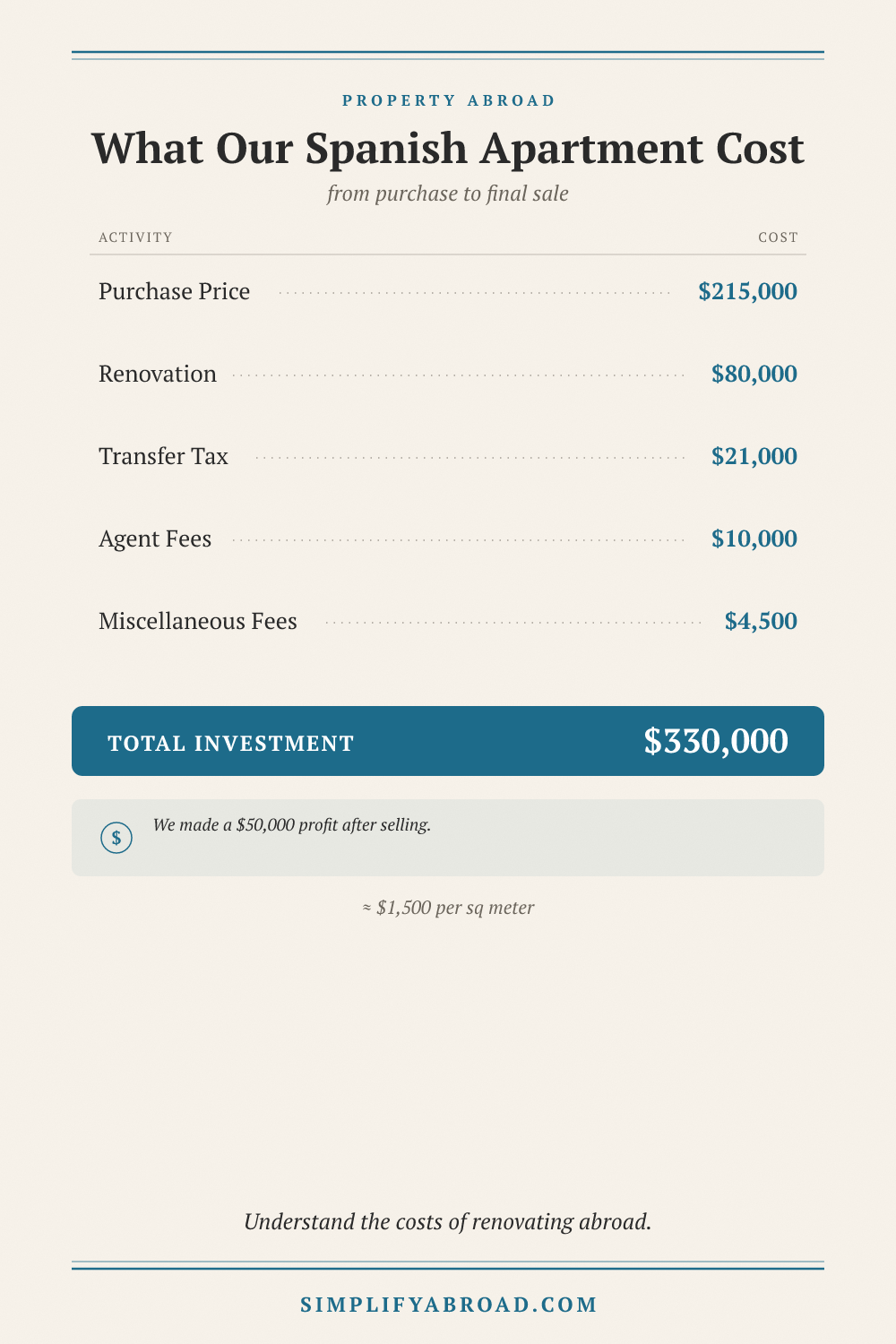
All‑in cost basis: ~$330,000
That ~$330,000 breaks down as:
- ~$215,000 for the purchase price
- $21,000 for the 10% transfer tax
- ~$10,000 for the seller’s agent fee at purchase
- $2,000 for the lawyer
- $1,000 as a tip to our buyer’s agent
- ~$1,000 for notary and registration
- ~$80,000 for the full renovation
Total: about $330,000 all‑in.
Based on the sale price versus that cost basis, we estimate our gross profit at roughly $50,000 before selling‑side costs and capital gains tax.
On the selling side in Spain, the direct transaction costs were lighter than on the purchase side. We paid:
- About $1,200 in a local tax calculated based on the property’s square footage
- About $500 to the notary
- Our agent’s commission, which was a couple percent of the sale price
Compared to the purchase side (10% transfer tax plus all the extras), these selling‑side taxes and fees felt relatively light.
The tricky part is taxes on the gain itself. Because we made a profit, we owe capital gains tax in Spain unless we reinvest the proceeds into Spanish real estate within 2 years, which is important to factor into any Spanish real estate profit calculation. There’s basically a two‑year window where, if we roll the gains into another Spanish property, we can potentially avoid that capital gains hit.
The capital gains tax rates we were told for this context are:
- Typically 19%
- Sometimes up to 25%, depending on the situation
And that rate is only on the profit portion, not the total sale amount. So in our case, that 19, 25% is calculated on the ~$50,000 profit, not on the full €385,000 sale price.
Simplified:
- Gross profit: ~$50,000
- Minus selling‑side costs: local tax (
$1,200), notary ($500), and a couple percent in agent fees - Minus capital gains tax on the profit if we don’t reinvest within two years
That’s the real spread between what we put into this place and what we walk away with.
Lessons Learned and What We’d Do Differently Next Time
If we did another renovation in Spain, the main thing we’d change is how hands‑on we are with walkthroughs before locking in big structural decisions, especially around terraces and anything that looks even slightly odd.
Overall, we had almost no major issues with the renovation itself and were very happy with the outcome. The contractor experience was generally smooth, and the one serious problem we hit wasn’t really in their control. The big surprise was an illegal overhang above the terrace that turned out to be a genuine safety issue.
When they went to install the new 3‑meter‑tall folding door to the terrace, they had to remove and work around part of the old structure.
That’s when everyone realized there was roughly 300 kilos of cement essentially hanging there, supported by what looked like 2x4s. It was an illegal overhang above the terrace, held up by makeshift supports in a way that posed a serious risk.
This hazard wasn’t visible until construction opened things up for the new door. None of us, or the contractor, or the previous owners would have noticed it during a standard viewing or typical pre‑purchase walkthrough. It only became obvious mid‑project, once the team started removing and working around that area.
So our main process tweak next time would be doing more detailed walkthroughs and conversations with the contractor about any odd structural elements before committing to major design features. Compared to a standard pre‑purchase inspection or quick walkthrough, we’d now push for a deeper, more technical look at terraces, overhangs, and anything that will carry weight if we’re planning big openings or structural changes.
Who This Strategy Might Work For (and How to Get Our Contacts)
This exact strategy really only works if you’re able to buy in cash and you’re comfortable stepping into a deal that traditional financing won’t touch because of paperwork issues when buying an apartment cash in Spain.
In our case, the whole opportunity hinged on the fact that the property had a registration issue that made it basically unfinanceable. The original listing agents couldn’t or wouldn’t fix it, which is why a cash buyer like us had so much use. A bank wasn’t going to approve a mortgage on it as‑is, so the buyer pool was tiny. That’s the key contrast: a traditional financed purchase on a fully documented property vs a cash purchase on a place with fixable (but currently broken) paperwork.
If you’re trying to reverse engineer a similar project in Valencia, you can copy the “buy, renovate, sell” structure on paper. But the part that made this deal work was:
- Cash purchase
- A fixable, known paperwork problem
- A seller who just wanted it gone
Without those three, it starts to look a lot more like a standard transaction than a “10‑week flip with profit.”
The other big factor was the team. Both our contractor and the selling agent we used were fair and bilingual (English and Spanish), which made a huge difference. That’s especially important if you don’t speak Spanish fluently and you’re trying to deal with real estate and renovations without reliable local help. Having a trusted bilingual agent, contractor, and lawyer changed the experience completely.
If you’re serious about moving to Spain, buying or selling in Valencia, or you just want contractor/agent/lawyer recommendations, reach out. We’re happy to share our contacts with people who are genuinely interested in this kind of project or just trying to figure out whether Valencia makes sense for their family.
For us, this project worked: we bought a problem apartment, turned it into a very livable home, and still walked away with a profit after all the Spanish taxes and fees. It only made sense because we had cash, a contractor we trusted, and were willing to stay pretty involved for those 10 weeks. If you’re weighing something similar in Valencia, my hope is that these actual numbers and details give you a clear baseline to compare against your own situation.
Frequently Asked Questions
What were the main reasons for purchasing the apartment in cash?
We chose to buy the apartment in cash because it had unregistered square footage, which limited the buyer pool to cash buyers only. This allowed us to negotiate a significantly lower purchase price compared to its market value.
How did the renovations impact the apartment's value?
The renovations transformed the apartment into a modern 3-bedroom, open-plan space with upgraded materials, which significantly enhanced its market value. Local agents estimated its worth at around $300,000 after the improvements.
What additional costs should buyers consider when purchasing property in Spain?
Buyers should account for transfer taxes, agent commissions, legal fees, and closing costs, which can add up to a significant amount beyond the headline purchase price. In our case, these additional expenses brought the total cost to approximately $250,000 before renovations.
Was the profit from the sale worth the effort and investment?
After selling the apartment, we reflected on whether the profit justified the work and cash tied up in the project. Ultimately, the experience provided valuable insights into the real estate market and renovation process in Valencia, making it a worthwhile endeavor for us.
Would you recommend this approach to others looking to invest in real estate?
Yes, if you're willing to invest time and effort into renovations and understand the local market dynamics, this approach can yield significant rewards. However, it's crucial to be prepared for the unexpected challenges that may arise during the process.
The Moving to Spain & Europe Guide
70+ pages on moving a family to Spain: the visas compared, the 90-day countdown, schools, and your first 30 days.


