
Valencia vs Malaga vs Alicante: Best Spanish City for Expat Families?

If you’re a family looking at Spain and you’ve narrowed it down to the Mediterranean coast, you probably have the same cities we did on your list: Valencia, Malaga and Alicante… plus a few northern wild cards people keep whispering about.
We moved from small‑town USA to Spain over four years ago with our kids, and we’ve been testing these places the way parents actually live: school runs, sports practices, teen independence, not just beach days and sangria.
Here I’m putting these cities side by side on the stuff that matters for real life with kids, transport, activities, heat, language, cost, safety, so you can see the trade‑offs clearly instead of guessing from Instagram photos when you’re moving to Spain with kids. I’ll also talk about the northern gems like Oviedo and Bilbao that weren’t even on our radar at the beginning, but probably should’ve been.
- Valencia offers a balance of city amenities and a small-town feel, making it highly walkable and community-oriented for families.
- The choice between Valencia, Malaga, and Alicante should be based on personal lifestyle preferences, particularly regarding city size, safety, and daily needs.
- Hidden gems like Bilbao and Oviedo are worth considering for expat families seeking alternatives to the more popular cities.
🎬 Check out Original Content
Click above to experience the full content!
How We Narrowed Down Where to Live in Spain as an Expat Family
We didn’t start with cities; we started with criteria.
When we first began planning our move from the US to Spain over four years ago, our “best Spanish city for expat families” list came from asking what we actually wanted day to day: sunshine, language, and safety.
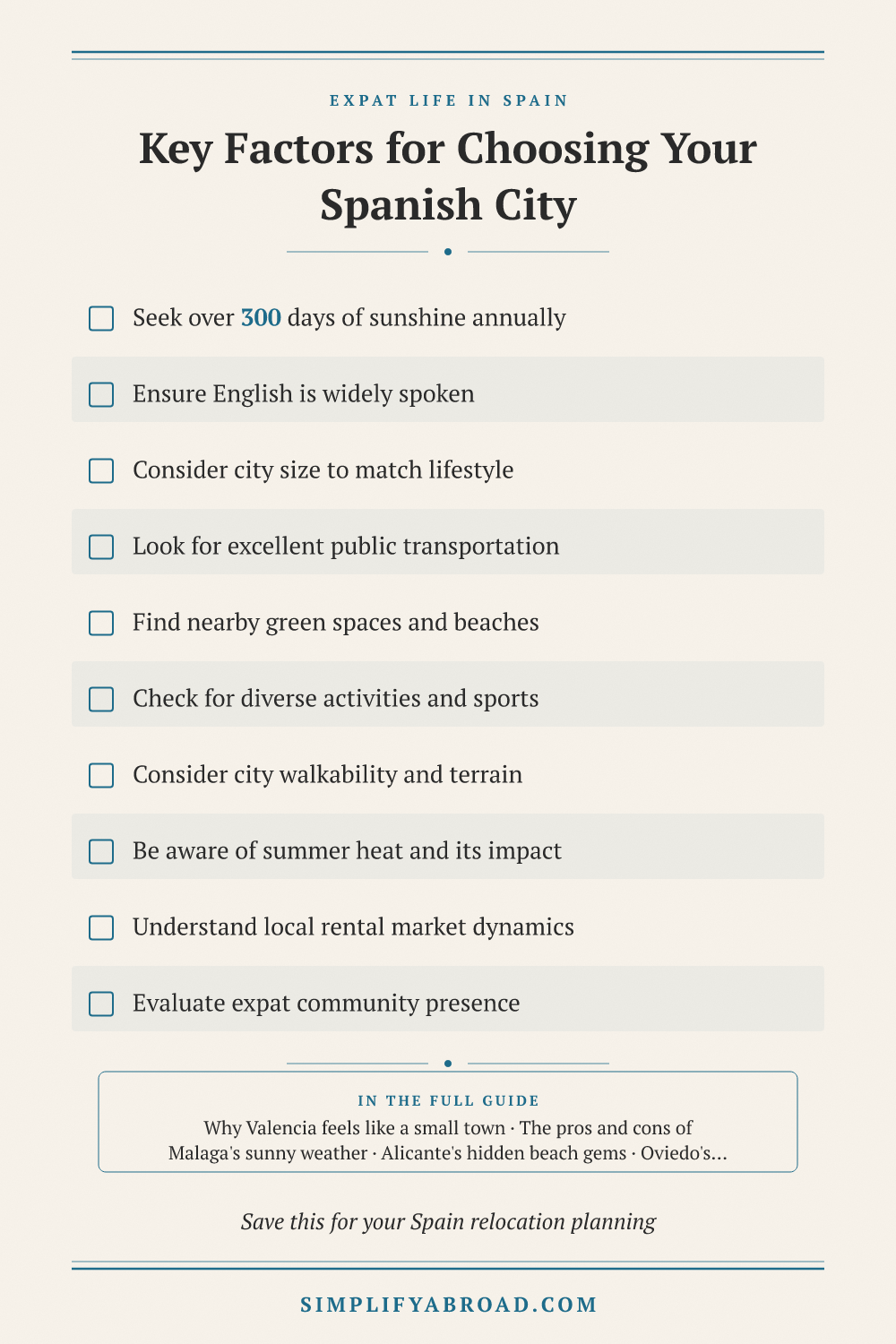
For us, that meant Aubrey wanting 300+ days of sun, both of us wanting a widely spoken language (Spanish), and both of us caring a lot about safety as a baseline for moving to Spain with kids. Those filters are what pushed us toward the classic “Valencia vs Malaga vs Alicante for families” debate instead of a “Madrid vs Valencia vs Malaga” one.
Madrid and Barcelona technically check the language and safety boxes, and they’re two of the best cities in Spain for expats in general, but they didn’t match our lifestyle. We visited both and found them beautiful and fun to visit, but we just can’t fathom walking from one end of Madrid or Barcelona to the other. They feel too vast for us. I only recommend Madrid and Barcelona if you specifically want a major city.
Our small‑town roots are a big part of why those bigger places felt like too much. Michael’s hometown is about 50,000 people. I’m from a very small town in Ohio. That’s why mid‑sized cities felt like the right middle ground: big enough to have what we need with kids, but not so big that they feel endless.
So while other people might be debating Madrid vs Valencia vs Malaga, we pretty quickly focused on Valencia, Malaga, and Alicante as the mid‑sized options expats most often debate between, and then kept an eye on “hidden gem” places like Bilbao, Oviedo, and Seville that come up in those best‑cities‑in‑Spain‑for‑expats conversations when choosing the best Spanish city for expat families. For us, that mix of 300+ days of sun, Spanish as the everyday language, and a scale that fits our small‑town comfort zone is what shaped where we looked for walkability and transport.
City Size, Vibe and Walkability: Valencia vs Malaga vs Alicante for Families (Plus Bilbao and Oviedo)
If your main filter is “does this feel like a real, livable city for a family or like a resort?”, Valencia and Bilbao are on one side of the spectrum, Malaga is on the opposite side for us, and Alicante and Oviedo sit somewhere in the middle.
Valencia is technically a big city, but it doesn’t feel like Madrid or Barcelona at all. Madrid and Barcelona feel vast and overwhelming to us; Valencia feels like a town where “everyone knows everyone,” especially once kids start sports. Once our kids started playing, the city just kept feeling smaller because you keep running into the same families.
That “big but small” thing shows up in day‑to‑day life too.
Valencia is very flat and highly walkable, and everything our teenage daughter needs is within about a 15‑minute bus or metro ride or walk. Most daily needs are in that 15‑minute radius, which is a big part of why it feels like a lived‑in community instead of a destination.
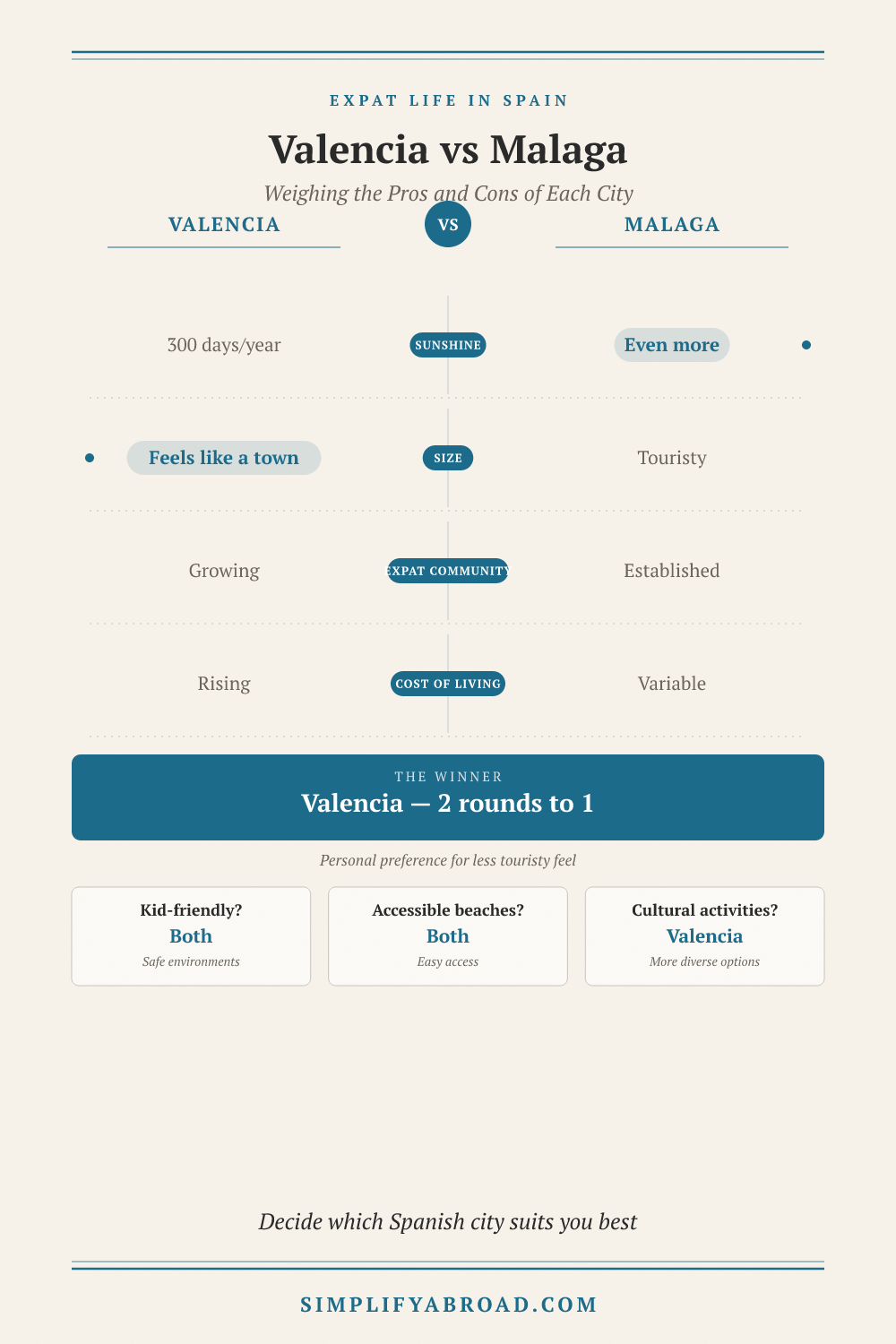
Malaga, for us, lands in a totally different category. If Valencia feels like a city you actually live in, Malaga feels like a place people visit. Michael explicitly says, “I straight up don’t like Malaga… it feels so touristy and like a worse Oahu or Honolulu… it just feels like a tourist trap.” So if you’re comparing Valencia vs Malaga for families and you care about that community feel, we put Valencia firmly in the “lived‑in city with community” bucket and Malaga in the “resort/tourist vibe” bucket.
Alicante sits between those two in size and feel, but when we put Valencia vs Alicante side by side, Valencia wins for us on both center‑city vibe and walkability. Alicante’s city center is “cute” and “okay,” but it didn’t feel on the level of Sevilla or Valencia. Valencia’s center feels more substantial and more charming to us.
On top of that, Alicante’s walkability is more challenging than Valencia’s because of the hills. Valencia is very flat; Alicante reminded us of dragging bags up hills in Madrid. You can absolutely walk in Alicante, but if you’re visualizing that easy, flat, 15‑minute‑everywhere lifestyle with kids, Valencia fits that picture much more closely.
Up north, Bilbao is one of our favorite cities and probably the closest in overall feel to Valencia. When we compare Bilbao vs Valencia, both feel like complete, livable cities that “kind of have everything” you need. They both feel like proper, full cities rather than resorts. The main difference in this specific comparison is that Bilbao is greener and on the ocean, but the core feeling of “this is a place you could actually live your life” is similar.
Oviedo, also in the north, is where you’d go if you like the idea of that community feel but want something smaller. If Valencia is the larger, more cosmopolitan option, Oviedo is a good option if you’re looking for a small‑town vibe. It still feels like a proper city, but on a more intimate scale, very clean and quieter.
So if you’re trying to choose the best Spanish city for expat families and your priorities are walkability, transport, Valencia public transport, and that “we actually live here” feeling, our rough spectrum looks like this:
- Bigger, complete, livable cities: Valencia, Bilbao
- Smaller‑town, quieter version of that: Oviedo
- Smaller, hillier, “cute but okay” center: Alicante
- Tourist‑trap feel (for us): Malaga
Public Transport, Walkability and Kids’ Independence
Public transport and walkability were huge for us because they directly affect how independent your kids can be, especially once you’ve got a teenager. This is where Valencia really separated itself from places like Madrid, Barcelona, and even cities we liked a lot, like Alicante and Sevilla.
In Valencia, our teenage daughter can get basically everywhere she needs to go in about 15 minutes by bus, metro, or walking. And the key thing is: in Valencia, if something looks close on the map, it’s actually close in real life, about 15 minutes. In Madrid or Barcelona, something that looks “just across town” on the map can easily be 45 minutes away.
That 15‑minute reality in Valencia is a big reason we feel comfortable letting our teenager go out and explore on her own.
The public transportation in Valencia is really good, and that combination of good transit plus a compact city makes a big difference when you’re thinking about kids’ independence and day‑to‑day life.
The physical layout matters too. Valencia is flat, which sounds like a small thing, but it changes how you live. Walking is easy, rolling luggage is easy, and that flat terrain supports that 15‑minute radius feeling.
In Alicante, the contrast is obvious. Alicante is hillier, and those hills make walking and moving around with bags noticeably harder than in flat Valencia. We actually compared Alicante’s hills to Madrid, remembering yanking our bags up the hill there. So if you’re looking at Valencia vs Malaga vs Alicante for families and walkability is high on your list, Alicante’s hills are something to factor in, especially if you’re imagining kids walking home or you’re hauling groceries or suitcases every day.
Sevilla sits in an interesting middle space in this whole “Spain cities walkability” question. When we visited Sevilla in February or March, we found it very walkable within the city. In that sense, it felt closer to Valencia than to Madrid or Barcelona in terms of how easy it is to get around on foot. But unlike Valencia, Sevilla doesn’t have a nearby beach.
So if your priority is kids’ independence and you’re asking which is the best Spanish city for expat families from a transport and walkability standpoint, Valencia’s mix of a true 15‑minute city feel, really good public transport, and flat terrain is what pushed it ahead for us. Madrid and Barcelona can mean 45‑minute cross‑city trips. Alicante is more physically demanding because of the hills. Sevilla is very walkable but doesn’t give you the beach.
Activities for Kids and Adults: Which Cities Actually Have Options?
If activities and sports are a big part of your family life, Valencia and Bilbao sit in a different category from places like Alicante, Oviedo, or some of the more retiree‑focused coastal spots. Valencia and Bilbao are where you go if you want to be able to say, “it’s here… you’ll find it,” and actually mean it.
In Valencia, that looks very concrete. For adults, you can find men’s volleyball, art classes, jiu jitsu, MMA, golf (including a brand new golf simulator), baseball leagues, flamenco, and football (soccer). For kids, on top of the usual football options, there are kids’ flag football teams that travel around Spain.
That kind of thing is exactly what tends to be missing in smaller cities lower on our list: it’s not that they have nothing, it’s that the breadth just isn’t the same.
A place like Alicante or Oviedo might give you a couple of mainstream options, but not necessarily men’s volleyball plus jiu jitsu plus baseball leagues plus a golf simulator plus kids’ flag football that travels.
Day to day, the experience also feels different. In Valencia, the pattern is: if you can think of an activity, “it’s here… you’ll find it,” but you might have to keep asking and searching, digging into smaller communities and word‑of‑mouth networks to track it down. In some of these other cities lower on the list, you do less digging because there’s simply less there once you start looking; the menu is shorter from the beginning.
Bilbao is the one northern city that really echoes Valencia on this front. It’s described as a larger city that “kind of has everything… everything you kind of need is there,” in the same way Valencia “kind of has everything you need” for both kids and adults.
So in terms of the best Spanish city for expat families who care about sports and hobbies, the basic framework is:
- Maximum choice and variety: Valencia, Bilbao
- Fewer, more standard options (okay if you’re fine with that): Alicante, Oviedo and similar smaller places
If you’re the type who’s going to be signing kids up for three different sports and looking for your own hobby nights, that Valencia/Bilbao tier matters a lot.
Beaches and Green Spaces: Everyday Access, Not Just Holiday Photos
If beach access and green space are high on your list, Valencia is the one that kept ticking both boxes for us, with Alicante and Bilbao also strong on the “water” side, and Sevilla clearly an inland choice.
From central Valencia, we can reach big green spaces for the dogs and for exercise within 15 minutes, and we can reach the beach in about the same time. That 15‑minute window is really the key difference when you put Valencia next to Alicante, Malaga, Bilbao and Sevilla.
In Valencia, you’ve got the Turia there as this huge green corridor cutting through the city, and there’s always exercise in the Turia, people running, biking, walking dogs all the time. On top of that, you can take a bus directly to the beach in Valencia, or a metro that gets you pretty close with a bit of walking, so from the city center you’re not choosing between “park day” and “beach day” based on logistics. Both are easy.
In Alicante, in terms of pure beach quality, outside the city you get absolutely phenomenal beaches, gorgeous, about a 20‑minute drive away. If you’re happy to hop in a car and go 20 minutes, Alicante really shines for beaches just outside the city. But the trade‑off is that the city beaches, not so much.
So Valencia vs Alicante for families comes down to: do you want quick transit access from the center to both beach and green space (Valencia), or are you okay with driving 20 minutes to get to those absolutely phenomenal beaches outside the city (Alicante), knowing the ones in town aren’t on that same level for everyday life.
Malaga sits in the same “coastal” bucket as Valencia and Alicante, but our focus with Malaga was more on how crowded and touristy it felt than on specific beach details. So if you’re comparing Valencia vs Malaga vs Alicante for families and you care about everyday access, Valencia gives you that 15‑minute bus or metro plus short walk to the water and to the Turia, Alicante gives you those stunning beaches 20 minutes by car outside the city but weaker city beaches, and Malaga, for us, was more about the crowds than about a particular beach or park setup.
Bilbao is another one where you get easy access to water, but it’s a different kind of coastline than Valencia or Alicante. Bilbao is next to the beach and on the ocean, not the sea, so the water is colder, and you’re in a more obviously coastal lifestyle. When we contrast Valencia vs Bilbao, it’s really: Valencia on the sea with that quick bus/metro access and the Turia as a major green corridor, versus Bilbao on the ocean with colder water and greener surroundings in general.
Sevilla and Oviedo are the outliers in this group. Sevilla is a beautiful, walkable city but has no nearby beach; it’s an inland option. If you specifically want a place with a beach, Sevilla is not it. Oviedo is also inland, but surrounded by green, very lush landscapes.
So for families who care about both beach and everyday green space:
- Valencia: 15 minutes from center to both beach and a huge green corridor
- Alicante: phenomenal beaches 20 minutes by car outside the city, weaker city beaches
- Bilbao: ocean city, colder water, very green surroundings
- Sevilla: inland, no beach
- Oviedo: inland, very lush and green
Weather and Heat: Valencia vs Malaga vs Alicante vs the North
Climate was one of our original non‑negotiables, but after a few Spanish summers our take is a lot more nuanced, especially when you line up Valencia, Malaga, Alicante, and the north side by side.
In Valencia, August is “super brutal.” We both feel like “every year it is… hotter and hotter and hotter,” and that intense heat is now creeping into parts of July. Locals have told me that when they were little, August mornings and late nights sometimes required a light sweater. That’s completely gone now.
At the same time, Malaga is understood to be even hotter than Valencia, and “very, very sunny… even more sunny days than Valencia,” so if Valencia’s August already sounds like too much, Malaga is basically that turned up a notch, though people do say it’s a bit drier.
You really feel how extreme August is in Valencia in how the city behaves. A lot of people just leave for most of the month, and we estimate that “most of the businesses are closed for like, three weeks in August.” Air conditioning is becoming more common because people “don’t have a choice,” but a lot of the housing stock here just wasn’t built for AC, so you get this combination of rising heat and buildings that are playing catch‑up.
The broader south, Sevilla, Granada, Cordoba, Cadiz, Malaga, gets very hot, with Sevilla especially known for a dry, intense inland heat. We visited Sevilla in February or March and already found it hot, and locals there were very clear: do not come in August.
If you’re choosing between Valencia and Alicante, the big difference people point to is sunshine. Valencia already has plenty of sun, but Alicante has “lots of sun” and reportedly “30 days more of sun than Valencia” if that matters to you. Malaga fits on that same southern, sun‑chasing spectrum: hotter than Valencia, “very, very sunny,” and with even more sunny days than Valencia.
So if you’re the kind of person who wants maximum sun and doesn’t mind serious heat, Valencia vs Malaga vs Alicante is really a question of how far you want to push it beyond an already hot, already sunny baseline on the Mediterranean coast.
The north is a different world. Oviedo’s weather, for us, is basically “perfect”: summers are “not as hot as Valencia,” it’s green, clean, safe, and it “does rain a bit more, but it doesn’t rain as much as Spanish people say it rains.” Bilbao and the north in general, think Oviedo, Bilbao, Santander, Galicia, are greener, rain more, and have cooler temperatures than the south.
On a personal level, we lean toward cooler overall.
I like heat more than cold, but even then, the combination of “super brutal” Augusts in Valencia and knowing Malaga and Sevilla are even hotter has pushed us to appreciate places like Oviedo more. We also know people from Texas who absolutely love the heat in Valencia and the south, so if you’re coming from that kind of background, Valencia vs Malaga vs Alicante vs the north might land differently for you.
If you’re sensitive to heat and trying to pick the best Spanish city for expat families, the north (Oviedo, Bilbao) moves way up the list. If you’re a sun‑chaser who’s fine with serious summer temperatures, Valencia, Malaga, and Alicante stay in play, with Alicante winning on sheer number of sunny days and Malaga and Sevilla taking the prize for intensity.
Free guideThe Moving to Spain & Europe GuideGet it free →
Cost of Living and Rents: Valencia vs Northern Hidden Gems
Cost is where Valencia and the northern “hidden gems” like Oviedo start to diverge pretty sharply.
On the Valencia side, both rental prices and purchase prices have gone up quite a bit compared to when we arrived four years ago, but rentals have moved the most. Back then, Valencia really felt like the cheaper alternative to Madrid and Barcelona. Now, as more people realize their money goes further here than in those two cities, Valencia’s prices are catching up.
You’ve got Americans, British, people from the Netherlands and Germany coming in as expats, and that international demand is one of the things pushing rents up.
At the same time, some people who first moved to Madrid or Barcelona are relocating to Valencia because their money goes further here, and that just adds another layer of pressure on the rental market.
Then you’ve got the remote work piece. There are locals from Barcelona and Madrid who can now work remote and choose to live in Valencia instead. So you’ve got people earning Barcelona or Madrid salaries but deciding they’d rather be in Valencia, and that shift is part of why rents are getting more and more expensive compared to four years ago.
Oviedo sits on the other side of that comparison. Compared directly to Valencia rent prices, Oviedo is obviously down quite a bit, and sits in that “so cheap, cheap wise” category but still feels clean and safe. If you’re trying to stretch a single income or you’re coming in as a remote worker, that gap really matters.
If you’re moving money over from another currency to cover those rents when you move to Spain with kids, tools like Wise have made it a lot easier for us to move dollars into euros without getting hammered on fees.
So if budget is tight and you’re hunting for the cheapest cities in Spain for expats, Oviedo has a clear edge on pure numbers while still giving you that high quality of life. If you want more going on and you’re okay with the fact that Valencia rent prices have gone up quite a bit in the last four years because of expats and people coming in from Madrid and Barcelona, then Valencia still makes sense.
The trade‑off is pretty straightforward:
- Valencia: bigger, better‑known expat hub, more expensive, more pressure on rents
- Oviedo: hidden gem, much cheaper cost of living, clean and safe, smaller‑city feel
English vs Spanish: Language Environment in Valencia, Malaga, Alicante and the North
If learning and using Spanish is important to you, Malaga and Alicante sit on one end of the spectrum, and Valencia, Bilbao, and especially Oviedo sit on the other.
In Malaga, there is a lot of English in daily life, especially in restaurants and hospitality. A couple of years ago, even when we spoke Spanish in restaurants, staff would quickly switch to English as soon as they heard our Spanish wasn’t perfect yet. There’s so much English spoken in Malaga that it would be very easy to live there without ever really learning Spanish.
Michael believes Malaga has the second most retirees in all of Spain, and that big retiree and expat population really reinforces English usage and expat bubbles.
It’s very easy in Malaga to just slide into an expat group, an expat community, and never speak Spanish. We explicitly don’t think moving to Spain and never speaking Spanish is the way to do it.
Alicante feels similar in terms of who lives there, even though we haven’t detailed it as much as Malaga. We think Alicante might actually be the number one retiree place in Spain, which likely increases the English presence there as well. So if you’re comparing Malaga vs Alicante for something like “best Spanish city for expat families” and you mainly care about how much English you’ll hear, both have large retiree populations and strong expat presence, with Malaga’s English environment the one we’ve experienced and can describe more concretely.
Valencia sits in the middle. There are English speakers, but far fewer than Malaga, and Spanish is much more dominant in daily life. You can find English in some contexts, but you’re not surrounded by it in the same way. For people thinking about “English in Valencia” or “Valencia vs Malaga vs Alicante for families,” Valencia is more Spanish‑forward, which can be helpful if you actually want to learn and use the language while still not feeling totally isolated.
Once you go north, the balance shifts even more. In Oviedo, there is not much English, so you really do need to practice your Spanish. Compared to Malaga, where you can basically live in English, Oviedo forces you to use Spanish because little English is spoken. If your goal is to avoid the expat bubble in Spain and actually speak Spanish every day, that difference between Malaga and Oviedo is pretty stark.
Bilbao adds the twist of a local language, Euskera. It’s in the Basque Country, so Euskera is very present, but locals behaved with us a lot like people in Valencia. When they realized we didn’t speak the local language, they switched to Spanish immediately. So if you’re worried about Euskera vs Spanish in Bilbao, in day‑to‑day life people were totally fine just moving into Spanish.
That’s where the comparison with Barcelona and Valencia gets interesting. In Barcelona, when we spoke Spanish, about one out of three people would keep speaking Catalan to us even when we used Spanish, or they would switch to English instead of Spanish. We experienced that as unhelpful, because we were actively trying to use Spanish.
In Valencia, when people speak Valenciano and we respond in Spanish, locals almost always switch to Spanish without a problem.
Bilbao felt similar to Valencia in that way: both have strong local languages (Valenciano and Euskera), but locals in both cities consistently and easily switched to Spanish when we addressed them in Spanish.
So if your priority is “learn Spanish in Malaga” versus “learn Spanish in Valencia” or even Bilbao/Oviedo as an expat family, the trade‑off is clear:
- Malaga / Alicante: softer landing with lots of English and big expat bubbles, but easy to avoid Spanish
- Valencia / Bilbao / Oviedo: much more Spanish‑forward, with Oviedo the most “you must use Spanish” of the bunch
Safety, Cleanliness and Everyday Annoyances
Safety was one of our three big criteria when we chose Spain, and on that front Spain as a whole has felt solid, but the day‑to‑day reality of safety and cleanliness looks very different in Valencia, Oviedo, and Bilbao once you’re actually walking around with kids and a dog. We go deeper on that in is Spain a safe place to live.
If you’re asking “best Spanish city for expat families” purely on safety + cleanliness, Oviedo is the one that keeps popping to the top for us. We describe Oviedo as green, clean, safe, and it might actually be the cleanest city in Spain. It usually gets a lot of awards for cleanliness, and we believe it’s even won “cleanest city” awards a couple of years in a row.
Bilbao, while we don’t dwell on it as much, fits that same general northern Spain pattern in our heads: clean and orderly, nothing that set off alarms for us, and it just quietly did its job on the safety/cleanliness front.
Valencia is where the contrast really shows up. On paper and in real life, safety in Valencia has been fine for us. We walk our kids and dogs to school, we’re out and about, and we feel okay doing that.
Where Valencia loses points for us compared to Oviedo (and what you might not see in a “Valencia vs Málaga vs Alicante for families” comparison at first glance) is cleanliness, specifically one very real, very annoying thing: dog poop.
When we walk the kids and dogs to school in Valencia, we stop in a library area with a big green space for the dogs to go to the bathroom. That part is convenient. The problem is everything around it.
I’m constantly telling the kids “watch out, watch out” as they literally jump over piles of dog poop on the sidewalk. Because of that, I avoid letting the kids walk in the green space near the library before school so they don’t get anything on their shoes.
For a city that’s generally safe, that daily “watch out” soundtrack and the mental load of steering kids around messes is a real quality‑of‑life thing.
People who’ve lived here longer will tell you that about 10 years ago there apparently wasn’t a rule to clean up after dogs, and it was really bad.
So Valencia now vs 10 years ago: yes, it’s cleaner than it used to be. But even with that improvement, dog poop on sidewalks and in green spaces is still way more than it should be for our liking.
So if you’re comparing Valencia’s walkability and transport to somewhere like Oviedo or even Bilbao, here’s how we see it:
- Oviedo: benchmark for green, clean, safe
- Bilbao: clean and orderly, nothing that worried us
- Valencia: feels safe, but you do trade that off against a very specific, very visible dog‑poop problem that affects how we move our kids through the city every single morning
Expat and Retiree Communities: How “Expat-y” Do You Want It?
If you care about how “expat‑y” a place feels day to day, Malaga and Alicante are on one side of the spectrum, Valencia is in the middle, and Oviedo/Bilbao are on the very local end.
Between Malaga and Alicante, both are very retiree‑heavy, but in slightly different ways. Malaga has a ton of expats and retirees and is believed to have the second most retirees in all of Spain. Alicante, on the other hand, is thought to be the number one retiree destination in Spain, with lots of retirees.
Malaga’s retiree scene was described as kind of like Florida, where “everyone comes down” to retire. Alicante has that same “retiree magnet” feel, and we literally say it’s “maybe good if you’re a retiree… maybe that’s what you’re looking for,” but it’s not what we’re looking for as a family.
That retiree / expat density shapes how each place feels to live in. In Malaga, having a ton of expats and retirees is explicitly listed as both a pro and a con. The pro is that community is easy: you show up and there are already expat bubbles, social circles, and English‑speaking services. The con is tied to the same thing: in Malaga you could easily “never leave” the expat bubble and never speak Spanish.
Alicante is similar in that the large retiree population shapes the vibe; if you’re actually retiring, that might be perfect, but for us it didn’t feel like the fit for our stage of life.
Valencia sits in a different spot. It does have a growing expat community, and we’ve seen that expats from Madrid and Barcelona are moving here because their money goes further in Valencia. So you do see other foreigners and other Spaniards who’ve relocated, but Valencia still feels very Spanish and local in daily life.
Compared side by side, Malaga has a much denser expat/retiree scene and a stronger, easier expat bubble; Valencia feels more balanced between locals and newcomers, which matters if you want your kids hearing Spanish on the playground and not just English in expat spaces.
If you push further north to Oviedo and Bilbao, you move even more toward the “local” end of the spectrum. Unlike Malaga and Alicante, Oviedo and Bilbao are not described as expat‑heavy at all. They feel more local and Spanish/Basque, with less English around and fewer expat bubbles.
So if you’re trying to decide the best Spanish city for expat families or thinking about whether to retire in Malaga or Alicante, the trade‑off is pretty clear:
- Malaga / Alicante: instant expat/retiree community, strong bubbles, easy English
- Valencia: middle ground, real expat community, but still very Spanish day‑to‑day
- Oviedo / Bilbao: very local, fewer expats, less English, more immersion
Hidden Gem Cities We Wish We’d Considered: Oviedo, Bilbao and Sevilla
If we were choosing again after four years in Spain, Oviedo, Bilbao and Sevilla are three cities we honestly wish had been on our radar alongside Valencia, especially if you care about climate, cost, language and walkability when comparing the best cities in Spain for expats.
If you put Oviedo next to Valencia, Oviedo is the “pretty hidden gem” in the north that feels like a small town: smaller, greener, very safe, and significantly cheaper than Valencia, while Valencia is larger, hotter and more expensive.
Oviedo is so clean that we’ve said it might actually be the cleanest city in Spain, and it’s not just us saying that, it’s won cleanliness awards a couple of years in a row, whereas Valencia feels clean enough but doesn’t hit that same “wow, this is spotless” level.
In summer, Oviedo doesn’t get anywhere near as hot as Valencia, and while it definitely rains more than Valencia, it’s not as rainy as a lot of Spanish people claim when they talk about “the north.” That cooler, greener, rainier profile is exactly why more locals are heading to places like Oviedo, Gijón, Santander and Galicia to escape the heat, while many expat families still default to the classic Valencia vs Malaga vs Alicante comparison.
The trade‑off is language: there’s very little English in Oviedo, so if you want to practice Spanish and avoid expat bubbles, Oviedo is great; if you need more English around, Valencia still wins.
Bilbao, on the other hand, is the northern city that, for us, feels the most like Valencia in terms of overall vibe and “completeness.” We absolutely love Bilbao; it’s awesome and kind of has everything you need in the way Valencia does. Both are proper cities with culture, services and good everyday livability, but Bilbao is a larger city that’s greener than Valencia, rains more, and sits on the ocean, whereas Valencia is on the Mediterranean with milder water and less rain.
That ocean piece matters: Bilbao has a beach but with colder water, while Valencia has warmer water and a more classic Mediterranean beach experience. Climate‑wise, Bilbao gives you cooler, wetter weather; Valencia gives you hotter, drier summers (though still milder than some southern inland cities).
Language‑wise, Bilbao is in the Basque Country, where Euskera is spoken, but locals readily switch to Spanish when needed, so day‑to‑day you’re mostly in Spanish, similar to Valencia, just with that extra Basque layer in the background. If you want a Valencia‑style “complete city” but greener and cooler, Bilbao is the northern option we’d put very high on a “Bilbao for expats” shortlist.
Sevilla is almost the opposite end of the spectrum from Oviedo and Bilbao when you’re thinking north vs south Spain for expats.
Compared with Valencia, Sevilla is inland, with no nearby beach at all, but it’s gorgeous, absolutely stunning and so pretty, and also very walkable in a way that will feel familiar if you like Valencia for walkability and transport.
Valencia combines city life with easy beach access and milder (though still hot) summers; Sevilla gives you a dry heat and a very urban, historic feel but zero beach, so if you need a beach, Sevilla is not for you. When we visited Sevilla in late winter, it was February or March, we already found it hot, and locals were very clear that August is much worse, which is a different level of heat than even Valencia or Malaga.
For some expat families, a random detail that matters: Sevilla has a Costco, which Malaga, Alicante and Valencia don’t, so if you’re the kind of family that cares about that, it’s worth noting when you’re comparing living in Sevilla without a beach vs the coastal cities.
We also mention Granada as a smaller southern option in this inland group, but if you’re choosing between Sevilla vs Granada, we see Sevilla as the stronger overall recommendation for most people because of how complete and walkable it feels.
On the content side of all this research, we’ve leaned on tools like ContentFold to help us turn these long, messy family debates into something organized enough to be useful for other parents.
Zooming out, the big trade‑off is north vs south Spain for expats. Oviedo and Bilbao sit in that cooler, greener, rainier north, alongside places like Gijón, Santander and Galicia (we haven’t been to Galicia yet but hope to go soon), while Sevilla, Granada, Malaga, Cordoba and Cadiz are in the hotter, sunnier south, where the heat can be extreme in summer.
We’ve heard great things about Cordoba and Cadiz without having visited yet, and we didn’t want to push everyone only toward the north, because some people really don’t like rain and genuinely prefer more sun and heat.
So if you want cheaper, cooler, very Spanish and low‑English, Oviedo is a pretty hidden gem we’re pretty happy with as a recommendation; if you want a Valencia‑like “complete city” but greener, rainier and on the ocean, Bilbao is the one we absolutely love; and if you want a stunning, walkable southern city and you don’t need a beach, Sevilla is the inland city we’d highlight first, with Granada as the smaller alternative.
Final Verdict: Which Spanish City Should You Choose as an Expat Family?
If you’re trying to pick the “best Spanish city for expat families,” it really does come down to what you actually want day to day: how much heat you can handle, how important a beach is, your budget, your language goals, and how you feel about expat bubbles.
If you want a major city, Madrid and Barcelona should be at the top of your list. If you don’t need that big‑city scale, the three names that come up the most in expat family conversations are Valencia, Malaga and Alicante.
Between those three, Valencia is still the one I’d put in the “best city in Spain for expat families” bucket if you want a balanced life: mid‑sized, very doable with kids, strong public transport, walkability, lots of activities, easy access to both beach and green space, and a good mix of locals and expats so you can integrate without feeling isolated.
Malaga, on the same grid, is the one you pick if your top priorities are maximum sun, easy flights and a big expat community, and you’re fine with more touristy vibes and more intense heat. Compared to Valencia, Malaga wins on sun, airport connections and the size of the expat scene, but you trade away some of that more “balanced family life and integration” feel.
Alicante, in that same Valencia vs Malaga vs Alicante for families comparison, tends to make more sense for retirees than for families: lots of sun, access to beautiful beaches just outside the city, but it doesn’t really scratch the “big‑city feel” itch. So if you’re asking where to live in Spain with kids, I’d lean Valencia; if you’re asking where to retire with sun and beaches, Alicante starts to look better.
Once you bring the north into the picture, the Valencia vs Oviedo vs Bilbao question is really about climate, cost, and how “local” you want your day‑to‑day life to be. Valencia is hotter, more expensive, and more expat‑friendly. Oviedo is ideal if you want a smaller, very clean, safe and affordable city, don’t mind some rain, and you actually want to be pushed into speaking Spanish because there’s a much more local feel and less of an expat bubble. Bilbao sits somewhere in between: if you like Valencia’s overall feel but you’d prefer greener landscapes, cooler weather and an ocean setting, Bilbao is a strong option. We honestly wish Oviedo and Bilbao had been on our radar before we moved, because things might have ended up differently if the kids weren’t now settled in Valencia.
Sevilla is a different trade‑off again. If you’re comparing Sevilla vs the coastal options like Valencia, Malaga or Alicante, Sevilla is what you choose if you love heat, don’t need a beach, and want a gorgeous, walkable southern city. You’re trading beaches for beauty, walkability and a dry, intense heat. For some people that’s perfect, for others the lack of a beach is a dealbreaker.
Climate is one of the biggest deciding factors that keeps coming up. More locals are heading north (Oviedo, Gijón, Santander, Galicia) to escape the southern heat, and that actually mirrors our own growing preference for cooler climates. We personally lean toward cooler weather now and see the north as very attractive. At the same time, people from Texas and similar climates often love the heat in Valencia and the south and really don’t like cooler weather, so for them, Valencia, Malaga, Alicante or even Sevilla can feel exactly For us, Valencia remains our home base. It still feels like a top choice if you want that mid‑sized, family‑friendly city with good transport, beach and green space, and a realistic chance to integrate with locals while still having an expat community. But if we were starting from scratch, and the kids weren’t already settled in Valencia, we’d be looking a lot harder at places like Oviedo and Bilbao now that we know they exist and line up more with our current climate preferences.
Bottom line: there isn’t a single “best” Spanish city for expat families so much as a best fit for your heat tolerance, budget, language goals and how much of an expat bubble you actually want. Valencia still works really well for us, but if you’re dreaming of quieter streets and lower rent, or you know you’ll melt in August, one of the northern cities might make you a lot happier long‑term. My hope is that now you can look at Valencia, Malaga, Alicante and those northern options with a clearer lens and choose the place that matches your actual everyday life, not just your holiday fantasy.
Frequently Asked Questions
What are the main factors to consider when choosing a city for expat families in Spain?
Key factors include climate, language, safety, city size, and community feel. Each family's priorities may vary, so it's essential to identify what matters most to you and your children.
How does Valencia compare to Malaga and Alicante in terms of community feel?
Valencia offers a strong sense of community, feeling more like a lived-in city where families can connect, while Malaga has a more touristy vibe. Alicante falls somewhere in between, but Valencia is generally preferred for its walkability and local atmosphere.
Are there any lesser-known cities in Spain that expat families should consider?
Yes, cities like Bilbao and Oviedo are considered hidden gems for expat families. They offer a mix of amenities, safety, and a more authentic living experience away from the more tourist-heavy areas.
What makes Valencia a good choice for families specifically?
Valencia combines city amenities with a small-town feel, making it highly walkable and community-oriented. With most daily needs accessible within a short distance, it supports a family-friendly lifestyle.
Why did the authors choose not to consider larger cities like Madrid and Barcelona?
The authors preferred mid-sized cities due to their small-town roots, finding larger cities overwhelming and less conducive to their family's lifestyle. They sought a balance of amenities without the vastness that major cities offer.
The Moving to Spain & Europe Guide
70+ pages on moving a family to Spain: the visas compared, the 90-day countdown, schools, and your first 30 days.


